Bacterial Bloom And Cloudy Water
#How to Fix Bacterial Blooms in Your Aquarium: A Complete Guide
#Don’t Panic – Bacterial Blooms Are Easily Treatable
First of all, what I need you to do is settle down. Don’t panic! A bacterial bloom is easy to take care of, and after reading this guide, you’re going to feel much, much better.
A bacterial bloom can happen both in a new tank setup and in an established tank, but for both scenarios, the solution is going to be the same: don’t panic. Stick with me throughout this entire guide because I’m going to cover both scenarios.
Understanding the Two Types of Aquarium Bacteria
First, we need to discuss two types of bacteria that live in our tanks: heterotrophic and autotrophic. I know those are big words, but I’m going to make this very simple.
Heterotrophic Bacteria (The Cloud-Causing Bacteria)
The biggest difference is that heterotrophic bacteria feed on organic matter like:
- Fish waste (poop)
- Uneaten food
- Dead fish
- Dead plants
- Any organic material in your water
Autotrophic Bacteria (The Beneficial Bacteria)
Autotrophic bacteria, on the other hand, feed on inorganic matter like ammonia, nitrite, and nitrate. I’m sure you’re more familiar with this type. We’ll call these the beneficial bacteria. Easy, right?

Bacterial Blooms in New Tank Setups
Probably 90% of bacterial blooms happen during a new tank setup, and this is perfectly normal. Also known as a “bacterial blossom,” this happens because of the nutrient-rich new tap water you just added to your tank.
Why New Tank Blooms Occur
The organic matter in that water causes the cloud-causing bacteria to grow and rapidly reproduce. When I say rapid, I mean like minutes—in about 15 to 20 minutes, they can double in numbers!
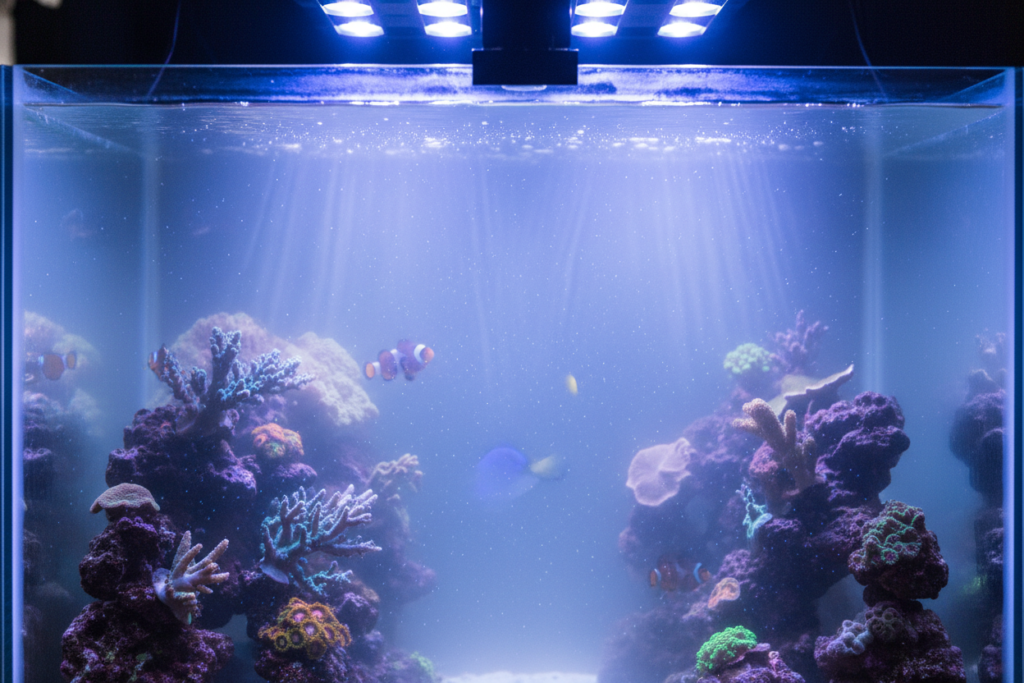
These are the type of bacteria that we don’t want in excess in our tanks. Why? Because this bacteria actually lives in the water column and reproduces so rapidly that once there are so many of them, they can be seen by the naked eye in your water. They are that milky white fog in your tank—the bacterial bloom.
Not only do they feed on the organics in your fresh, newly dechlorinated water, but if you have fish in the tank already while it’s cycling, they also feed on the organic waste from the fish.
The Solution for New Tank Blooms
The good news is that the solution to getting rid of these cloud-causing bacteria during a new tank bacterial bloom is simple: do nothing. That’s right—no water changes, no additives, no chemicals needed.
Water changes are actually going to make the cloud-causing bacteria left over in your tank reproduce even faster when you add in new nutrient-rich water again, and the bacterial bloom will just return. You’ll just be resetting the bloom every time.
With time, as your tank cycles, your beneficial bacteria (the nitrifying bacteria we do want in excess) will eventually grow and starve the cloudy water-causing bacteria away. Problem solved!
Bacterial Blooms in Established Tanks
If you’re experiencing a bacterial bloom and your tank is already established—meaning you’ve had it up and running with fish for a few months and you know for sure your tank has been cycled—and all of a sudden you get a bacterial bloom, this one’s a bit more tricky.
What Causes Blooms in Established Tanks
A bacterial bloom in an established tank means that something is out of whack with your ecosystem. Some organic compound in excess has found its way into your tank, and now the cloud-causing bacteria are back and reproducing rapidly again.
This could be caused by:
- Overfeeding: Maybe you went on vacation and someone got a little generous with the food
- Trapped food: Uneaten food got trapped under a rock or behind a piece of décor
- Too many fish added at once: Causing more fish waste to accumulate
- Dead fish: You could have a dead fish somewhere and not even know it
- Decomposing plant matter: Dead plants breaking down
The Dangers in Established Tanks
The issue for concern this time is that we probably have a bunch of fish in our established tank already. When a bacterial bloom occurs, you can get a spike in ammonia from all the organics that the bacteria are feeding on and mineralizing into ammonia. We all know that ammonia is deadly to our fish.
The problem is our good guys—the beneficial bacteria—need way more time to reproduce and catch up to the increase in ammonia.
The free-floating cloud-causing bacteria are also going to heavily deplete the oxygen in the tank. During a bloom, these guys can switch from aerobic to anaerobic, unlike the beneficial bacteria in our tanks (the autotrophic beneficial bacteria), which are just aerobic.

Treatment for Established Tank Blooms
- Dose with Seachem Prime: I recommend dosing your entire tank’s volume with Seachem Prime to detoxify that ammonia spike, keeping your water safe for the fish and giving your beneficial bacteria more time to grow and take care of it.
- Increase Surface Agitation: The cloud-causing bacteria will fight for all the oxygen in your tank. The cloudier it gets, the more oxygen it’s going to use up. Since you have fish in the tank, make sure you have adequate surface agitation for oxygen transfer. If you already do, you may want to add more during the bloom.
- Find and Remove the Cause: At this point, you need to find that underlying cause of the bloom:
- If it’s excess food or waste in your tank, vacuum that stuff up
- If it’s a dead fish or dead plants, scoop that stuff up and get it out of the tank
4. Wait: Once you’ve removed whatever extra organic material caused the bloom, all you need to do is wait. The heterotrophic (cloud-causing) bacteria will soon starve and die off, and you’ll be back to having crystal clear water in no time.
Key Takeaways for Aquarium Bacterial Bloom Management
- New tanks: Do nothing and let the cycle complete naturally
- Established tanks: Address the underlying cause, use Prime for ammonia spikes, and increase oxygenation
- Never panic: Bacterial blooms are temporary and treatable
- Avoid water changes during blooms: They can make the problem worse by adding more nutrients